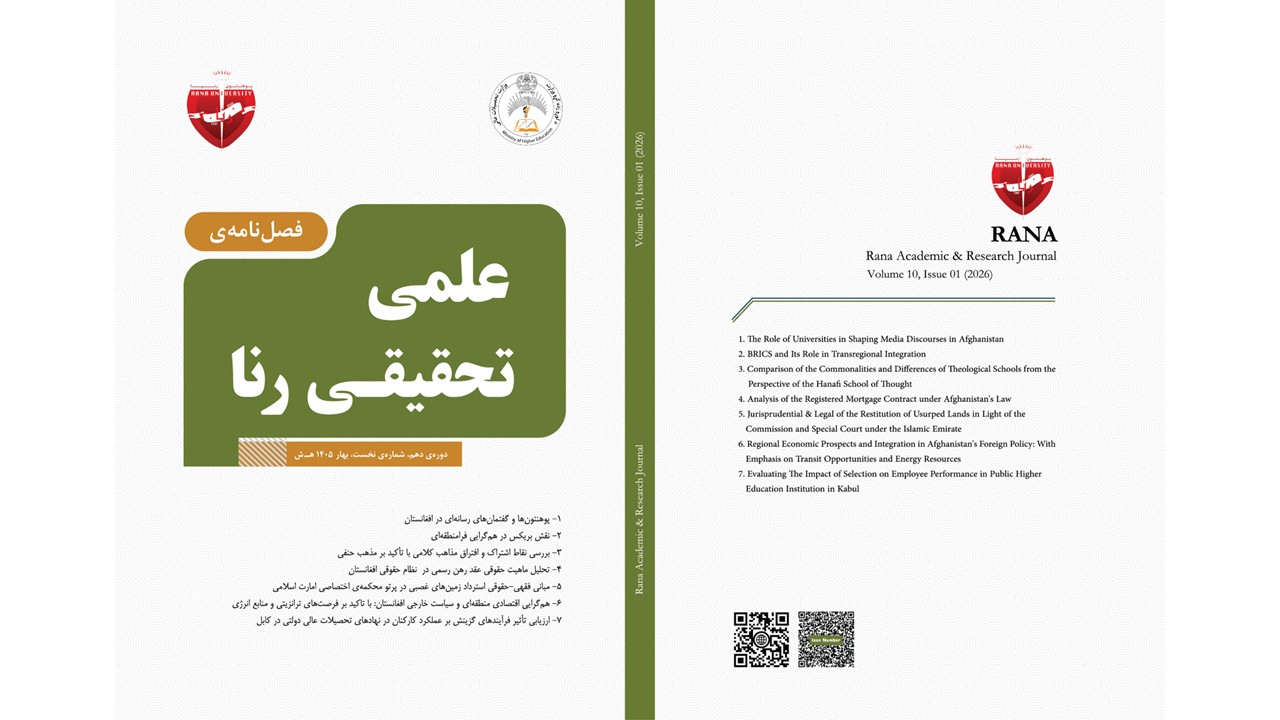
Evaluating The Impact of Selection on Employee Performance in Public Higher Education Institution in Kabul
DOI:
https://doi.org/10.65859/6a9975e200f05Abstract
The selection process is a critical function of human resource management that significantly influences employee performance by ensuring that qualified and competent individuals are appointed to appropriate positions. This study examines the impact of selection processes on employee performance in public higher education institutions in Kabul, Afghanistan. A quantitative research approach employing descriptive and explanatory research designs was adopted. Primary data were collected through a structured questionnaire administered to 30 teaching staff members from Kabul University, Kabul Education University, and Kabul Polytechnic University using purposive sampling. Data were analyzed using SPSS, applying descriptive statistics, Cronbach’s Alpha reliability analysis, Pearson correlation, and linear regression techniques. The findings revealed a strong positive and statistically significant relationship between the selection process and employee performance (r = 0.713, p < 0.001). Regression analysis further indicated that the selection process explained 50.8% of the variance in employee performance (R² = 0.508), demonstrating its significant predictive effect. The study concludes that systematic, transparent, and competency-based selection practices substantially enhance teaching effectiveness, productivity, and professional commitment among academic staff. It recommends that public higher education institutions strengthen merit-based recruitment systems by adopting standardized screening procedures, structured interviews, competency-based assessments, and transparent evaluation mechanisms to improve institutional performance and support the sustainable development of higher education in Afghanistan.
Keywords:
Downloads
References
Armstrong, M. (2021). Armstrong's handbook of human resource management practice (15th ed.). Kogan Page.
Becker, G. S. (1964). Human capital: A theoretical and empirical analysis, with special reference to education. University of Chicago Press.
Cable, D. M., & DeRue, D. S. (2002). The convergent and discriminant validity of subjective fit perceptions. Journal of Applied Psychology, 87(5), 875–884. https://doi.org/10.1037/0021-9010.87.5.875
Dessler, G. (2020). Human resource management (16th ed.). Pearson.
Edwards, J. R. (1991). Person–job fit: A conceptual integration, literature review, and methodological critique. In C. L. Cooper & I. T. Robertson (Eds.), International review of industrial and organizational psychology (Vol. 6, pp. 283–357). Wiley.
Kristof-Brown, A. L., Zimmerman, R. D., & Johnson, E. C. (2005). Consequences of individuals' fit at work: A meta-analysis of person–job, person–organization, person–group, and person–supervisor fit. Personnel Psychology, 58(2), 281–342. https://doi.org/10.1111/j.1744-6570.2005.00672.x
Mincer, J. (1974). Schooling, experience, and earnings. Columbia University Press.
Noe, R. A., Hollenbeck, J. R., Gerhart, B., & Wright, P. M. (2020). Human resource management: Gaining a competitive advantage (11th ed.). McGraw-Hill Education.
Noori, M. T., Amron, A., & Pakary, P. (2025). Influence of organizational power on human resources (HR) recruitment in Afghanistan: Nepotism, conflict of interest, and beyond. Journal of Information Systems Engineering and Management, 10(28s), 442–457. https://doi.org/10.52783/jisem.v10i28s.4346
Omari, N., & Barakzai, A. (2024). An examination of challenges in implementing human resource management principles in Afghanistan's workplace. Journal of Social Sciences, 7(2), 159–177. https://doi.org/10.62810/jss.v7i2.34
Ployhart, R. E. (2006). Staffing in the 21st century: New challenges and strategic opportunities. Journal of Management, 32(6), 868–897. https://doi.org/10.1177/0149206306293625
Rahmani, A. R. (2025). Human resource management in Afghanistan's Civil Service Commission (Republic Era): Challenges and strategic solutions. Sprin Journal of Arts, Humanities and Social Sciences, 4(4), 11–15. https://doi.org/10.55559/sjahss.v4i4.511
Robbins, S. P., & Judge, T. A. (2017). Organizational behavior (17th ed.). Pearson.
Rofcanin, Y., & Budhwar, P. (2025). Reinvigorating the micro foundations of human resource management: A narrative review. Human Resource Management Journal. Advance online publication.
Schmidt, F. L., & Hunter, J. E. (1998). The validity and utility of selection methods in personnel psychology: Practical and theoretical implications of 85 years of research findings. Psychological Bulletin, 124(2), 262–274. https://doi.org/10.1037/0033-2909.124.2.262
Taskin, N. (2025). Reducing AI bias in recruitment and selection: An integrative grounded approach. The International Journal of Human Resource Management. Advance online publication. https://doi.org/10.1080/09585192.2025.2480617
Downloads
Article information
- Section
- Articles
- Language
- English
- Pages
- 137-160
- Published
- 2026-06-21