Call for Paper
Rana University
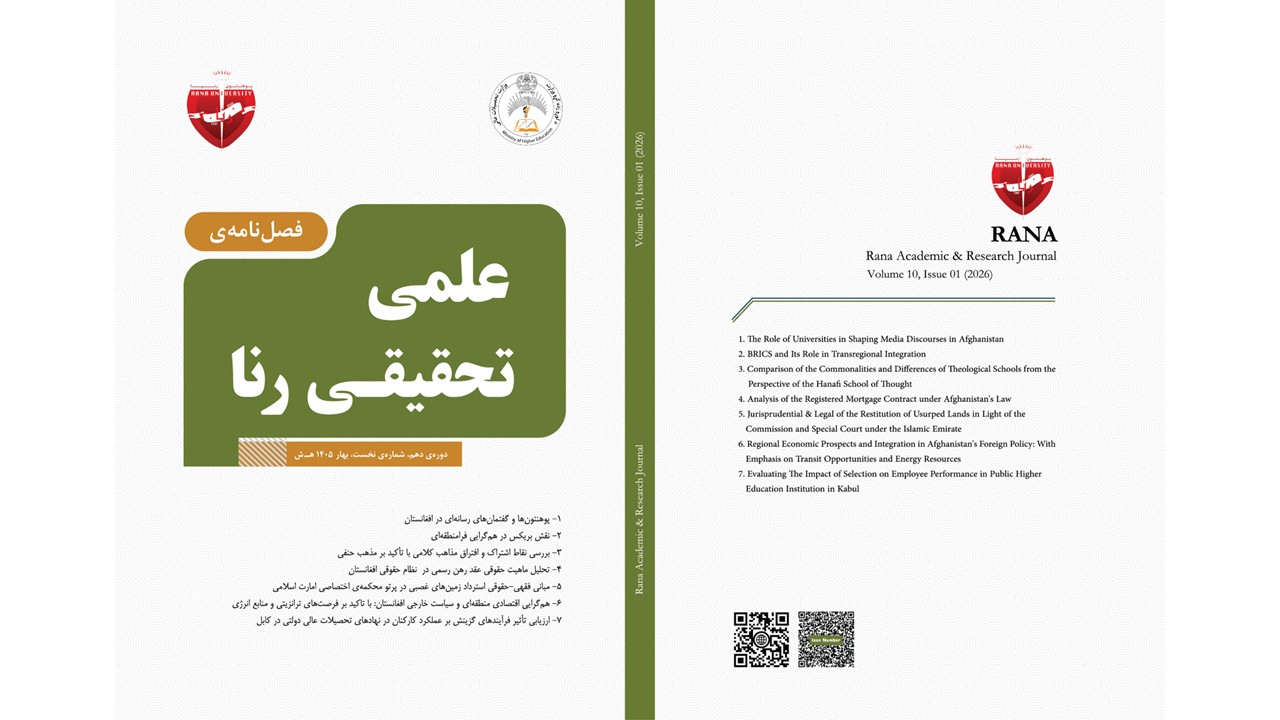
Rana University Scientific-Research Quarterly
The Rana University Scientific-Research Quarterly is a peer-reviewed journal published by Rana University, Afghanistan. Founded in 2014, it received an official license from the Ministry of Higher Education in 2021. It publishes research in the social sciences, with a focus on law, political…
- DOI prefix
- 10.65859
- Frequency
- Quarterly
- Peer review
- Peer review
- Article fee
- No Fee
From the journal
Announcements
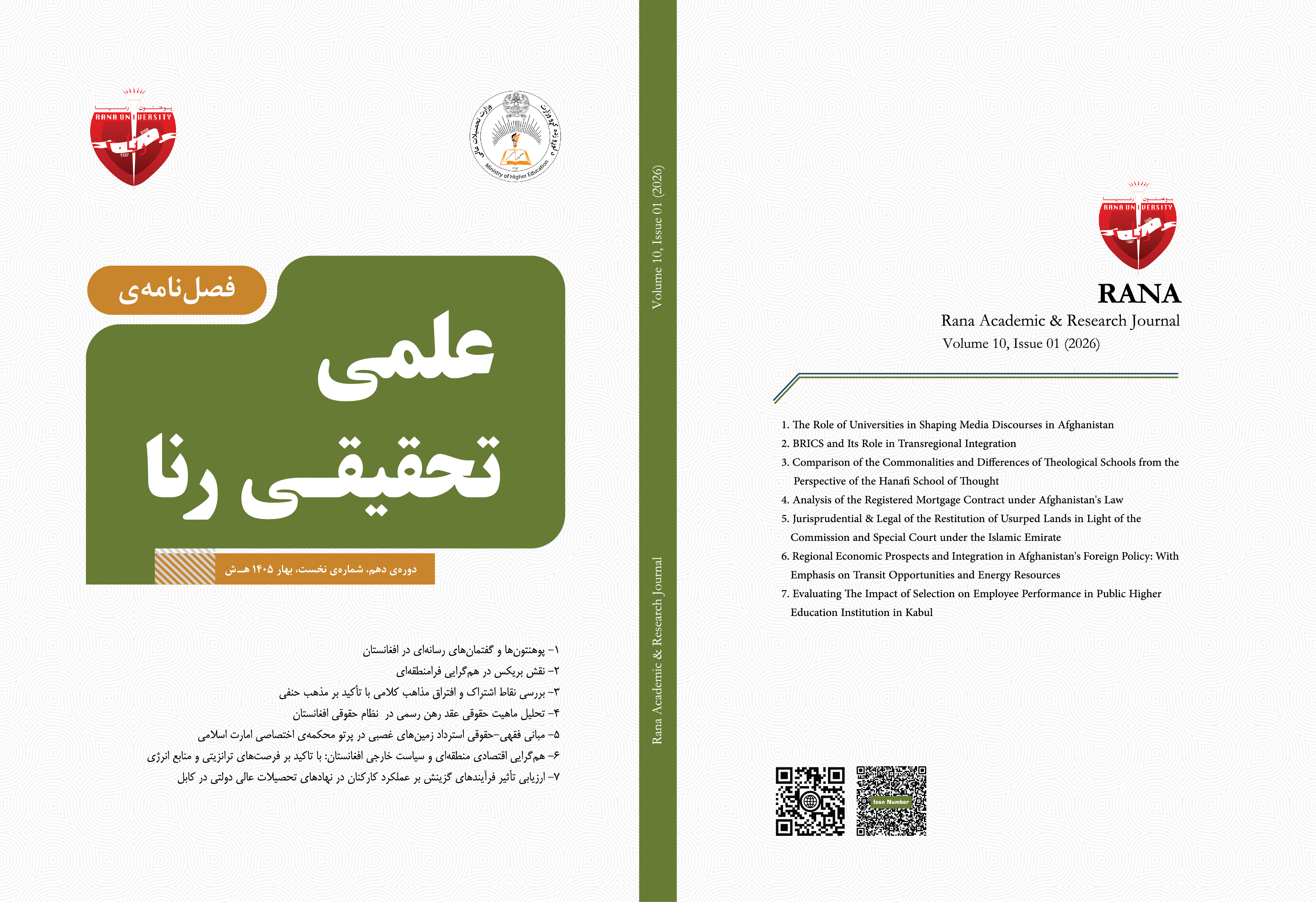
Vol. 10 No. 1 (1405): Rana Academic & Research Journal
Full table of contents
Published:
2026-06-22
Articles
-
Articles2026-06-21 1-20
The Role of Universities in Shaping Media Discourses in Afghanistan
n the contemporary world, universities and the media are recognized as two influential institutions that play a pivotal role in the production, dissemination, and reproduction of knowledge and public awareness. Accordingly, understanding the nature of the relationship between these two institutions…
-
Articles2026-06-21 21-42
BRICS and Its Role in Transregional Integration
In today’s world, it is impossible for countries to achieve their goals and reach growth and development without convergence with other regional and extra-regional powers. Therefore, five emerging powers chose the path of convergence in the form of BRICS in order to have a greater impact on the cur…
-
Articles2026-06-21 43-65
A Comparative Study of the Similarities and Differences among Theological Schools, with Emphasis on the Hanafi School
The commonalities and differences among theological schools of thought arise from the distinctions between theological sects such as the Ash'arites, Maturidites, and Mu'tazilites, which are among the most significant branches of Islamic sciences dedicated to the explanation of religious doctrines. …
-
Articles2026-06-21 67-90
Analysis of the Registered Mortgage Contract under Afghanistan's Law
A registered mortgage is one of the principal legal mechanisms for securing obligations under Afghan law, aimed at protecting creditors' rights and ensuring legal certainty in transactions, particularly those involving immovable property. The Civil Code of Afghanistan recognizes mortgages and class…
-
Articles2026-06-21 91-111
Jurisprudential & Legal of the Restitution of Usurped Lands in Light of the Commission and Special Court under the Islamic Emirate
This study analyzes and examines the legal and jurisprudential foundations of the establishment of the Commission for the Prevention of Land Grabbing and the Restitution of Emirate and State Lands, with particular emphasis on the Commission’s functional approach in relation to the role of the Speci…
-
Articles2026-06-21 113-135
Regional Economic Integration and Afghanistan’s Foreign Policy: Emphasizing Transit Opportunities and Energy Resources
Given the strategic importance of regional economic cooperation—particularly in the fields of energy, trade, and transit—among the countries of South Asia, Central Asia, East Asia, the Caucasus, and Europe, this study seeks to answer the following main research question: What impact do regional eco…
-
Articles2026-06-21 137-160
Evaluating The Impact of Selection on Employee Performance in Public Higher Education Institution in Kabul
The selection process is a critical function of human resource management that significantly influences employee performance by ensuring that qualified and competent individuals are appointed to appropriate positions. This study examines the impact of selection processes on employee performance in …
Most read
- Articles66 2026-03-20
The Concept of Peace and International Security in the Qur’an and the United Nations Charter
International peace and security are among the most significant concerns of the global community and constitute essential prerequisites for development, justice, and peaceful coexistence among nations. The Holy Qur’an and the Charter of the United Nations, as two influential sources in the religious…
- Articles13 2026-03-20
The Impact of Financial Inclusion on Economic Growth: Empirical Evidence from Afghanistan
Abstract Financial inclusion plays a vital role in promoting economic growth, particularly in developing economies. This study investigates the impact of financial inclusion on economic growth in Afghanistan over the period 2010–2020. Financial inclusion is measured using three indicators: number of…
- Articles12 2026-03-20
Islamic Rulings on Fasting and Breaking the Fast for Travelers on Airplanes and in Scandinavian Countries
With the expansion of air travel and the residence of Muslims in regions with unique geographical conditions, such as the Scandinavian countries where the length of day and night becomes abnormal during certain seasons of the year, determining the prescribed times of fasting (imsak) and breaking the…
- Articles11 2026-03-20
An Assessment of Political Journalists’ Use of X in Television News Topic Selection (Politicaljournalists of Kabul’s private TVstations, 1403)
In digital communications, social media play a significant role in transforming the flow of information and shaping journalists’ access to news sources. This study aims to examine the relationship between the use of X and news topic selection by political journalists working in private television ne…
- Articles10 2026-03-20
Afghanistan at the Intersection of Great Power Policies: Regional Implications of Public Policy (2004–2021)
Afghanistan, due to its strategic geopolitical position and institutional fragility, has consistently been influenced by the policy orientations of major powers. This study examines the impact of great-power policymaking on the formulation and direction of public policies in Afghanistan and its impl…
About the Journal
The Rana University Scientific-Research Quarterly is a peer-reviewed journal published by Rana University, Afghanistan. Founded in 2014, it received an official license from the Ministry of Higher Education in 2021. It publishes research in the social sciences, with a focus on law, political science, economics, journalism, and Islamic studies. Articles by faculty members, researchers and policy makers are accepted in Persian, Pashto and English. All submissions are screened for similarity before publication, and articles with more than 20% overlap with earlier texts are not published. The journal aims to publish scholarly research and to build a culture of research that supports the development of Afghanistan’s academic community
People
Full editorial team
Editorial board
-
Dr Mohammad Qais Rezvani
Managing Director Rana University -
Dr. Sayed Ahmad Rashid Ashrafi
Editor-in-Chief) Rana University